
A structured 4-phase system: gear, parking lot drills, neighborhood riding, ongoing practice, and license prep
Most people learn to ride a motorcycle from YouTube clips, riding buddies, or a weekend MSF course — and then they're on their own. No structured practice plan. No system for building real skills. Just "go ride and figure it out."
This guide is different. It's a complete training progression that takes you from your first time sitting on a motorcycle to riding on real streets with confidence — at your own pace, on your own schedule. Every phase builds on the last. Every drill has a purpose. Nothing is skipped.
Whether you're training at home before your MSF course, supplementing what you learned in class, or starting from zero with no formal training available — this is the roadmap.
This guide was written by a firefighter/EMT and MSF-certified Rider Coach.
After 11 years responding to motorcycle crashes and coaching hundreds of new riders, the patterns are clear: the riders who stay safe aren't the ones who got lucky — they're the ones who trained with a system. That's what this guide gives you.
Jump to section


- Phase 1 — Gear, Controls, Friction Zone, and First Parking Lot Drills
- Phase 2 — Neighborhood Riding (Shifting, Emergency Skills, PLAN Method)
- Phase 3 — From the Neighborhood Back to the Parking Lot (Training Loop + 5 Drills)
- Phase 4 — License Test Skills
- 4-Phase Training Schedule
- Get the Full Training System
Gear, Controls, Friction Zone, and Your First Parking Lot Drills
Before the motorcycle moves an inch, three things need to be locked in: your protective gear, your knowledge of every control on the bike, and your ability to feel the friction zone. Then you take it to a parking lot and start moving — in a very specific order.
Motorcycle Gear: Your Training Uniform

Your gear is what allows you to train, make mistakes, and walk away ready to keep learning. It's not optional — it's the baseline for every session.
Minimum standard for every ride:
- Full-face helmet — snug fit, chin strap fastened every ride. DOT + ECE rated when possible.
- Full-coverage motorcycle gloves — reinforced palms and knuckle protection.
- Long sleeves and durable pants — at minimum. The upgrade goal is armored motorcycle jacket and pants.
- Above-ankle boots — sturdy soles, secure closure, no loose laces.
That's the floor. Full motorcycle-specific armor — armored jacket, armored pants, motorcycle boots — is the goal. Gear up before touching the ignition switch. Every time. No exceptions.
Want the full gear breakdown?
Helmets (DOT vs ECE, fit, head shape), jackets, pants, gloves, and boots — including what to look for, what to avoid, and how to get the right fit.
Motorcycle Controls: Know Every Input by Feel

Before you move the motorcycle, you need to know what every control does — by feel, not by looking down. The goal is to locate and operate every control without taking your eyes off the road.
Primary controls:
Throttle (right grip) — roll on to add power, roll off to reduce. It should snap back to closed when released. Front brake lever (right hand) — squeeze smoothly and progressively. Never grab. Rear brake pedal (right foot) — press gently for balanced stops and low-speed stability. Clutch lever (left hand) — connects and disconnects engine power to the rear wheel through the friction zone. Shift lever (left foot) — press down for lower gears, lift up for higher gears. Handlebars — relaxed grip, elbows slightly bent. Tension in your arms fights the motorcycle's natural balance.
The start-up and shut-down sequence
Start-up: Key ON → Kill Switch ON → Confirm Neutral → Side Stand UP → Clutch IN → Press Start.
Shut-down: Kill Switch OFF → Key OFF → Side Stand DOWN.
Practice this with the engine off until the sequence is automatic. Then practice it live. You should be able to start and shut down the motorcycle without thinking about the order.
Practice assignment: Sit on the bike with the engine off and locate every control by feel. Close your eyes. Find the front brake. Find the clutch. Find the shift lever. Do this until your hands and feet know where everything is without looking.
The Riding SMART book walks through every control with photos and a QR-linked video you can watch right next to the bike. Designed so you can sit on the motorcycle, open the book, and match each control to the description.
Watch: Controls & Startup Walkthrough
The Friction Zone: The Foundation of Everything

If there's one skill that makes or breaks a new rider, it's this one.
The clutch lever works on a scale from 0 (fully pulled in — no power to the rear wheel) to 5 (fully released — engine drives the wheel directly). The friction zone lives between 2 and 3 — the narrow range where power starts to engage and the bike begins to move.
Every low-speed maneuver you'll ever do lives in the friction zone. U-turns, parking lots, tight corners, slow-speed traffic. All of it. Riders who control the friction zone smoothly look composed and confident. Riders who don't stall, lurch, and fight the bike at every stop sign.
The friction zone drill (do this before you ride)
- With the engine running and the bike in first gear, slowly release the clutch toward the friction zone.
- Feel the bike begin to pull forward. Don't let it move yet — just feel the engagement point.
- Pull the clutch back in fully.
- Repeat 10 times.
- Now add light front brake pressure as you pull the clutch back in — practice stopping smoothly.
- Repeat 5 times.
Simple. Foundational. Non-negotiable. This is the drill that everything else builds on.
For braking: squeeze, don't grab. Apply progressive pressure on the front brake (which provides 70–80% of your stopping power). Light, steady pressure on the rear brake stabilizes the bike. If you stall, stay calm and restart. Stalling is learning — it means you're working the friction zone.
Friction zone control is the skill that riders in the SMART Rider Training System spend the most time on early — because it's the one skill that either makes or breaks everything that comes after it. Getting it right now saves you from building bad habits that are harder to fix later.
Watch: Motorcycle Clutch Control & Braking Drills
Before You Ride: The SAFE-T Pre-Ride Check

Every practice session — every ride — starts with SAFE-T. It takes two minutes and it puts you in the right mindset before the bike moves.
SAFE-T Checklist
S — State of Mind. Focus and patience. Leave anger, stress, and distractions behind. If your head isn't right, the ride can wait.
A — Assume the Risk. Motorcycling carries real risk. Acknowledge it. Ride within your current skill level, not the skill level you wish you had.
F — Fitness. Are you physically and mentally sharp enough to ride? Fatigue, medication, alcohol, illness — any of these compromise your reaction time and judgment.
E — Equipment. Gear up. Every piece, every ride. Dress for the slide, not the ride.
T — Tires & Controls. Quick visual and functional check. Tire pressure, tire condition, controls functioning, lights working, chain tension (if applicable).
Make SAFE-T your ritual. Before every ride, every session, every time. This is how every ride starts from now on.
Watch: The SAFE-T Pre-Ride Checklist
The 4-Drill Progression: From Standing Still to Figure 8s
Find a flat, empty parking lot. Run SAFE-T. Then work through these four stages in order. Move to the next stage only when you feel comfortable — not just when you can complete the drill, but when it feels controlled and natural.
Stage 1 — Paddle Walking
Engine running, friction zone engaged, feet down. Walk the bike forward using your legs while the engine provides a little momentum. This builds trust with the friction zone while your feet are still on the ground. Back and forth across the lot. No rush.
Stage 2 — Feet Up
Same friction zone engagement, but now your feet come up onto the pegs. The bike balances itself through forward motion — you just have to let it. Release the clutch to the friction zone, feet up, coast to a controlled stop. Repeat until your feet go up naturally without hesitation.
Stage 3 — Continuous Riding with U-Turns
Now you're riding. Friction zone to move, gentle braking to stop, and your first real turns. Start with wide arcs, then tighten into U-turns. This is where committed head turns become critical — where you look is where the bike goes. Commit your chin to the turn. Don't look at the ground in front of the wheel. Look through the turn to where you want to end up.
Stage 4 — Figure 8s
Two U-turns linked together. This is the drill that brings everything into one fluid motion — friction zone, head turns, throttle control, smooth braking between transitions. If you can ride clean figure 8s in a parking lot, your low-speed control is real.
The SMART Rider Training System includes practice cones and step-by-step video walkthroughs for every stage of this progression — so you can set up the drill, scan a QR code, and watch exactly how it's done before you attempt it.
See What's IncludedWatch: Essential Riding Drills — Full Walkthrough
The Key Technique: Committed Head Turns
This deserves its own section because it changes everything about how the motorcycle handles in turns.
A committed head turn means turning your chin — not just your eyes — in the direction you want to go. Through the turn. Past the turn. To where you want to end up.
When you commit the head turn, three things happen naturally: your shoulders follow your head, your body weight shifts into the turn, and the motorcycle follows the line your body sets. When you don't commit — when you stare at the ground or look at the edge of the lot — the bike runs wide, you tense up, and the turn gets harder.
The most common mistake in motorcycle training
Not turning the head far enough. Exaggerate it. It should feel like too much at first. If you can have someone film you while you practice, do it — you'll see immediately that what feels like "way too much" head turn actually looks about right on video.
Practice committed head turns on every single turn during this phase. U-turns, figure 8s, every arc you ride. This is the technique that takes your turning from "fighting the bike" to "the bike goes where I look."
Neighborhood Riding: Shifting Gears, Emergency Skills, and Reading the Road
You've got your gear dialed, your controls memorized, and real parking lot time under your belt. If your figure 8s are getting smoother, that's your friction zone and head turns working together. Now you leave the parking lot and ride real streets for the first time.
Your First Neighborhood Ride

Your first ride out of the parking lot should be boring. Quiet residential streets, low traffic, familiar area. No highways. No busy intersections. Just you and the basics at real-world speed.
Shifting gears: The process is the same every time — roll off the throttle, pull in the clutch, shift (up or down), ease the clutch back through the friction zone, roll on the throttle. Smooth is the goal. Jerky shifts mean you're rushing through the friction zone. Let the clutch do its job.
Start in 1st and 2nd gear around the neighborhood. When that feels natural, work up to 3rd. There's no hurry. A common beginner mistake is forgetting to downshift before stopping — the bike will lurch or stall. Not dangerous, just uncomfortable. Downshift as you slow down so you're always in the right gear for your speed.
The Riding SMART book (part of the SMART Rider Training System) walks through each shift point and the most common shifting mistakes new riders make — with photos showing hand and foot position at every stage.
Watch: Your First Neighborhood Ride
Three Emergency Skills to Know Before You Ride in Traffic
Before you ride anywhere with other vehicles, these three skills need to be practiced in the parking lot at low speed. They're the physical tools you'll rely on when something unexpected happens.
Emergency Braking
Progressive squeeze on the front brake, firm press on the rear, both applied together. Eyes up, squeeze don't grab. Practice this at 15–20 mph: pick a stop point and hit it. Five controlled stops minimum before riding in traffic.
Emergency Swerving
Two quick countersteering inputs to change lanes without braking. Press left on the handlebars to go left, press right to go right. The handlebars do the work. Don't lean your body — just push.
Emergency Acceleration
Sometimes the safest move is to get out of the way. Roll on the throttle firmly and move through the threat. Knowing when to brake, swerve, or accelerate is what the PLAN method teaches you.
The PLAN Method: Your Riding Brain
This is the mental system that separates riders who get lucky from riders who are prepared. Every second you're on the road, PLAN is running in the background.
P — Position for Safety
Put yourself where you have the most visibility, the most escape routes, and the most time to react. Lane position matters. Following distance matters. Where you stop at an intersection matters. Every position you choose either gives you options or takes them away.
L — Locate Hazardous Situations
Scan constantly. Intersections, driveways, parked cars, lane changes ahead of you. You're looking for situations that could become threats — not waiting for them to become obvious. Eyes moving, head moving, mirrors checked every 5–7 seconds.
A — Assess Relevant Threats
Not everything you locate is a threat. A car in a driveway with no driver isn't a concern. A car in a driveway with brake lights on is. Assess means asking: is this about to affect me? How likely? How soon?
N — Navigate Active Threats
When a threat becomes real — a car pulling out, a light turning, gravel in your lane — you navigate it. That means one of three responses: brake, swerve, or accelerate. You choose based on what gives you the most space and the most control. PLAN gave you the time to choose. Without it, you're just reacting.
How to practice PLAN: On your neighborhood rides, narrate out loud. Call out what you're positioning for, what you're locating, what you're assessing. "Car at the intersection, no turn signal, watching their wheels... wheels are still, I'm clear." It feels weird at first. It works.
PLAN is one of the core frameworks in the Riding SMART book. The full chapter includes real-world scenarios, intersection diagrams, and lane positioning strategies you can study before your next ride — so you're not learning situational awareness for the first time on the road.
Get the Training SystemWatch: The PLAN Method — Full Breakdown
Bonus: MSF Written Test Prep
If you're planning to take the MSF course for your motorcycle license, there's a written test you'll need to pass. It covers road rules, hazard awareness, and riding fundamentals specific to the MSF curriculum. This video walks through what's on it, how the questions are structured, and what to focus on.
From the Neighborhood Back to the Parking Lot: The Training Loop and 5 SMART Rider Drills
You've ridden the neighborhood. You've shifted gears, run PLAN at intersections, and started building real situational awareness. Now you take what the street taught you and bring it back to the parking lot — because this is where the real improvement happens.
The Street → Parking Lot → Street Training Loop

This is the training cycle that makes riders better over time: the street reveals your weaknesses — maybe your U-turns felt shaky, maybe your braking wasn't as smooth as you wanted, maybe you tensed up in a turn. The parking lot is where you isolate those weaknesses and sharpen them. Then you go back to the street with more control.
Street → parking lot → street. That's the cycle. The riders who improve fastest aren't the ones who ride the most miles — they're the ones who practice the right things deliberately.
Most riders never go back to a parking lot after they pass their test. That's why most riders plateau. The ones who keep setting up cones and running drills are the ones who keep getting better — year after year.
Watch: From the Neighborhood to the Parking Lot
The 5 SMART Rider Drills
The parking lot isn't something you graduate from. It's where you keep getting better. Every skill you use on the road — low-speed control, braking, head turns, throttle management — gets sharper when you practice it in isolation. These five named drills each target a specific skill:
🎈 Balloon Drill — Slow-speed straight-line control. Friction zone, steady throttle, smooth stops. The foundation drill you return to every session as a warm-up.
👻 Ghost Drill — Figure 8s and tight turns at low speed. Head turns and friction zone working together under pressure. If you can ghost through a tight figure 8 without putting a foot down, your low-speed control is solid.
🪼 Jellyfish Drill — Controlled swerving. Quick countersteering inputs around obstacles. This builds the same emergency swerve skill from Phase 2 as a repeatable practice drill.
🔱 Tuning Fork Drill — Braking precision. Pick a stop point and hit it. Then move it closer. This builds the muscle memory for emergency braking — progressive, accurate, confident.
🐰 Rabbit Ears Drill — Acceleration and deceleration transitions. Smooth power on, smooth power off, repeat. Trains the throttle control that makes riding feel composed instead of jerky.
These five drills are introduced in the Riding SMART book. The full SMART Rider Drills book (included in the Training System) expands them into 24 progressive drills across three certification tiers — Copper, Silver, and Gold. Each tier tightens the tolerances, increases the speed, and adds new combinations. The system also comes with practice cones so you can set up every drill in any parking lot.
Get the Full 24-Drill SystemLicense Test Skills: Pass Your Motorcycle Riding Test
If you're working toward your motorcycle license, every state riding test evaluates four core skills. If you've been following this training progression, you've already been practicing all of them — you just need to know the scored format.
Cone Weave
Slow-speed navigation through offset cones. Head turns lead, friction zone keeps speed steady, handlebars do the steering. The same technique you've been building since Phase 1.
U-Turn Box
Tight U-turn inside a marked boundary. Your figure 8 skill applied to a defined space. Committed head turn, friction zone, rear brake drag for stability.
Quick Stop
Controlled emergency stop from a set speed. Progressive front brake, steady rear, stop in the shortest distance without skidding. The Tuning Fork drill is direct practice for this.
Obstacle Swerve
Maintain speed and swerve around an obstacle without braking. Countersteering only. The Jellyfish drill trains exactly this.
Notice something? Every one of these test skills maps directly to a drill you've already practiced. The cone weave is your parking lot navigation. The U-turn box is your figure 8s in a scored space. The quick stop is your Tuning Fork drill. The obstacle swerve is your Jellyfish drill. The test isn't a surprise when you've been training with a system.
The SMART Rider Training System includes the Motorcycle Test Prep Guide with the specific dimensions, speed requirements, and scoring criteria for every state riding test skill — so you can practice to the exact standard you'll be graded on. The included cones let you mark out the test course in any parking lot.
Get the Test Prep Guide + Training System4-Phase Training Schedule (Quick Reference)
Here's the full progression at a glance. Spend at least one week on each phase — more if you need it. There's no deadline. Competence, not speed, is the goal.
Phase 1 — Gear, Controls, and First Parking Lot Drills
- Get your gear squared away (full-face helmet, gloves, jacket, pants, boots)
- Sit on the bike and locate every control by feel — engine off
- Practice the start-up and shut-down sequence until it's automatic
- Friction zone drill: 10 engagement reps + 5 with braking
- Run SAFE-T before every session
- 4-drill progression: paddle walk → feet up → U-turns → figure 8s
- Committed head turns on every turn
Phase 2 — Neighborhood Riding
- Practice emergency braking in the parking lot: 5 controlled stops from 15–20 mph
- First neighborhood ride: quiet streets, 1st through 3rd gear, SAFE-T before you leave
- Practice shifting: roll off → clutch in → shift → ease through friction zone → roll on
- Run PLAN while riding — narrate what you're positioning for, locating, assessing
- If prepping for your license, review the MSF test prep material
Phase 3 — From the Neighborhood Back to the Parking Lot
- Identify weaknesses from street rides → isolate and practice in the parking lot
- Run the 5 SMART Rider Drills: Balloon, Ghost, Jellyfish, Tuning Fork, Rabbit Ears
- Keep the cycle going: street → parking lot → street
- SAFE-T before every ride, PLAN on every ride
Phase 4 — License Test Skills
- Practice the 4 scored skills: cone weave, U-turn box, quick stop, obstacle swerve
- Set up the test course dimensions in a parking lot
- Practice to the exact standard you'll be graded on
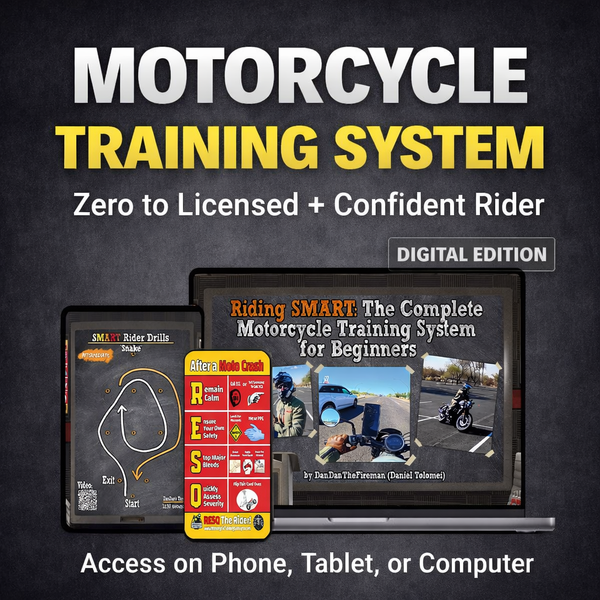
This entire 4-phase progression is built into the SMART Rider Training System. The box includes the Riding SMART book, the SMART Rider Drills book (24 progressive drills), the Motorcycle Test Prep Guide, the RESQ crash response guide, practice cones, and QR-linked video walkthroughs for every chapter and drill. Everything you need to train at your own pace, in your own parking lot.
Get the Full Training SystemWhat's in the SMART Rider Training System
This guide gives you the roadmap. The Training System gives you everything you need to execute it:
- Riding SMART book — the complete beginner training guide with photos and QR-linked video walkthroughs for every chapter. Covers gear, controls, friction zone, parking lot drills, neighborhood riding, PLAN method, emergency skills, and the street-to-lot training loop.
- SMART Rider Drills book — 24 progressive drills across three certification tiers (Copper, Silver, Gold). Each tier builds on the last with tighter tolerances, faster execution, and new combinations.
- Motorcycle Test Prep Guide — exact dimensions, speed requirements, and scoring criteria for every state riding test skill.
- RESQ Crash Response Guide — what to do in the first 60 seconds if you're in or witness a motorcycle crash.
- Practice cones — set up every drill in any parking lot.
- QR-linked video walkthroughs — scan a code, watch the technique on your phone, then practice it.
Everything in one box. Structured, progressive, and designed for riders who want to build real skill — not just collect tips.

