What video games, relationships, and personal growth taught a firefighter/EMT about surviving on a motorcycle.
Watch: 7 Reasons Your Biggest Riding Problem Isn't the Road — It's You
I spent 11 years as a firefighter and EMT. I've seen what happens when a rider's skills don't match the moment. And after years of teaching motorcycle safety, I can tell you the conversation almost always goes the same way:
"The car came out of nowhere."
"The road was slippery."
"There was nothing I could do."
I get it. The external stuff is real. But here's what nobody wants to hear:
The most important thing holding you back as a rider is yourself.
Not the road. Not the other drivers. Not your bike. You.
Jump to Section
- 1. The Game Got Harder. Your Skills Didn't.
- 2. "Just Ride More" Is the "Just Be Yourself" of Motorcycle Advice
- 3. Every Trait You Have Can Save You or Kill You
- 4. Trying Harder Isn't the Same as Getting Better
- Setup & Attention: Remove the Friction
- 5. Your Brain Gives You One Answer. Learn to Ask for More.
- 6. Reverse Engineer the Rider You Want to Be
- 7. Feeling Weak Doesn't Mean You Are Weak
- The Through-Line
The Game Got Harder. Your Skills Didn't.
If you've ever played a video game, you know the tutorial is forgiving. Enemies are slow. The environment is simple. You can button-mash your way through because the game isn't really trying to kill you yet.
Then the difficulty spikes. Enemies get faster. The margin for error disappears. Moves that worked in the tutorial get you destroyed in the endgame. If you didn't level up your fundamentals while the game was easy, you're going to hit a wall — hard.
Riding used to be the tutorial.
Twenty years ago, traffic was slower. Drivers were more attentive. Intersections were simpler. You could ride with mediocre braking skills and the environment would forgive you. You'd get close calls instead of collisions. The game was easier, so sloppy fundamentals didn't kill you.
That era is over. Distracted driving has exploded. Vehicles are bigger with worse sightlines. Traffic is faster and denser. The difficulty has spiked, and it's not coming back down.
Here's what I've learned from years of responding to motorcycle crashes and then teaching riders how to avoid them: when the external environment gets harder, the only thing you can control is your internal capability. You can't make drivers put their phones down. You can't shrink the Chevy Tahoe blocking your sight line. The world isn't going to get easier for you. So your skills, your awareness, your emotional regulation on the bike — all of it needs to be closer to 100% than ever before.
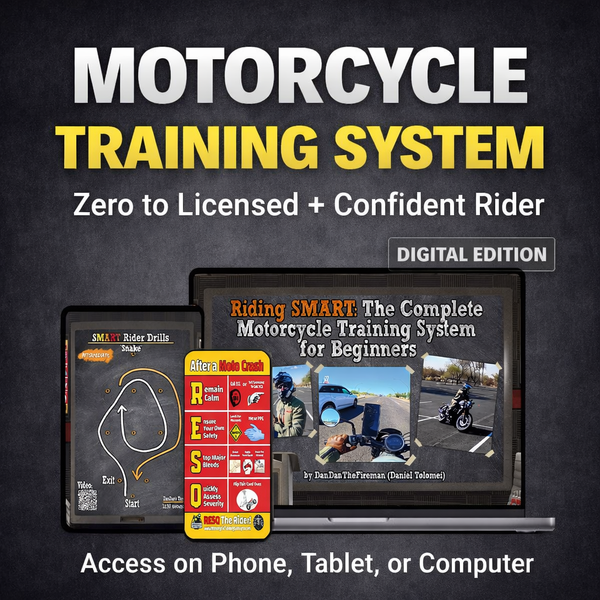
That's what Riding SMART is — a system for closing the gap between where your skills are and where the road demands they be. Not motivation. Not inspiration. A structured approach to getting your internal game to match the external difficulty.
"Just Ride More" Is the "Just Be Yourself" of Motorcycle Advice
You know the worst dating advice ever given? "Just be yourself." It sounds wise. It feels supportive. And it's completely useless if "yourself" hasn't figured out how to communicate, listen, or show up for another person.
"Just ride more" is the same thing.
It came from an era when the environment was forgiving enough that exposure alone was education. When traffic was gentler, you could learn by just riding — the way some people could stumble into a great relationship without ever doing any self-work. The environment would correct you slowly and relatively safely.
That doesn't work anymore. The road doesn't gently teach you now. It punishes you. The feedback loop isn't "that was a close call, I should adjust." It's a trip to the trauma center.
"Just be yourself" works if you've already done the work to become someone worth being. "Just ride more" works if you've already built the skills worth reinforcing. Without that foundation, more exposure just means more repetitions of the same mistakes.
Every Trait You Have Can Save You or Kill You — Depending on How You Use It
One of the hardest lessons I ever learned wasn't on a motorcycle. It was in my own personal growth — realizing that the qualities I thought were weaknesses were actually tools I didn't know how to use yet. And the qualities I thought were strengths were sometimes the things getting me in the most trouble.
It's like being dealt a hand of cards. A two and a four doesn't look great. But if you understand the game, there are flush opportunities, straight draws, all kinds of plays available — if you know how to work the hand instead of wishing you had different cards.
This applies directly to how you ride.
Fear
Riding culture treats fear as weakness. Push through it. Man up. Twist the throttle. But fear is your brain's threat detection system doing exactly what it's supposed to do. The healthy version: acknowledge the fear, identify what specific risks it's pointing to — decreasing radius turn? gravel? fatigue? — make a plan, then ride. The unhealthy version: suppress it and ride beyond your capability, or let it freeze you into never developing at all.
Aggression
Some riders are wired hot. They push pace, get impatient, want to go faster. Riding culture either celebrates this or condemns it. Neither is right. Aggression channeled into deliberate skill development makes you someone who trains harder, who pushes braking distances in practice, who builds genuine capability. Aggression left unregulated on a public road is how you end up as a cautionary tale.
Caution
Overly cautious riders may never develop because they avoid every situation that would challenge them. But caution properly deployed means they never outride their skill level, which keeps them alive long enough to actually get good.
I've worked with all of these rider types. The ones who succeed aren't the ones with the "best" personality for riding. They're the ones who figured out how to use what they've got.
Trying Harder Isn't the Same as Getting Better
There's a pattern I've seen in relationships that translates perfectly to riding. One partner senses something is wrong, so they try harder. They do more. More gifts. More texts. More effort. But they never stop to ask: is this effort actually landing? Does my partner need more of this, or do they need something completely different?
The effort is real. The exhaustion is real. But the results never come because the effort isn't aimed at the right thing. More isn't better. Better is better.
Riders do this constantly.
The 15,000-miles-a-year rider who assumes volume equals skill. They're grinding. They're putting in the hours. They're "doing the work." But what's the return on those miles?
If every mile reinforces the same habits — the same sloppy braking, the same late visual pickup, the same mid-corner corrections — then all that effort is just making bad habits more deeply ingrained. You're not building skill. You're wearing a rut deeper.
The Question That Changed How I Ride
I rode for years before I started asking myself the hard question: For every hour I spend on this motorcycle, how much safer am I actually becoming? When I couldn't answer that honestly, I knew something had to change. That question is what eventually led me to build a structured training system — because I needed one myself.
That's why SMART Rider Drills are built on a progression: Beginner, Easy, Intermediate, Hard, Expert. Each level tests your ability to control the bike under slow speed — the place where most riders have the least confidence and the most to gain. You're not just practicing — you know exactly where you are in the progression and what the next level demands. The drill tells you the truth. You either hit the benchmark or you didn't. And when you move from Beginner to Easy, from Easy to Intermediate, you feel the progress.
That's the difference between riding a lot and riding better.
Remove the Friction Before You Ride
The internal game needs mental bandwidth. If your bike is fighting you — uncomfortable seat, jacket bunched up, nothing secured for a two-hour ride — you're burning attention on friction instead of on the road. Every piece of your setup, from gear to on-bike storage, should reduce friction so you can put your attention on the decisions that actually matter.
On-Bike Storage That Stays Out of Your Way
I'm currently installing a Viking Bags Iron Born Blade sissy bar with foldable luggage rack on my Honda Rebel 500 — a clean, bike-specific mount that doesn't force me to compromise on fit. If you're on a cruiser and tired of bungee-cording your life to the passenger seat, their catalog is worth a look.
Your Brain Gives You One Answer. Learn to Ask for More.
As an EMT, you walk into someone's house and your brain starts telling you a story before you've even knelt down next to the patient. Elderly woman on the floor? Brain says she fell. Hip fracture, maybe. Call it in, transport, done.
But that's not what training teaches you to do. Training teaches you to resist that first answer. Why did she fall? Did she trip, or did she get dizzy? Is she on blood thinners? Did she lose consciousness before she hit the ground? Is this a fall — or is this a cardiac event that happened to end on the floor? The first answer your brain gives you is a starting point, not a conclusion. Accepting it without question is how patients get hurt.
There's a concept in medicine called differential diagnosis — the discipline of forcing yourself to consider every possibility, not just the obvious one. I carried that into every call. And eventually, I realized it applies to riding the same way.
Most riders never learn to do this with their own close calls.
When something goes wrong, your brain gives you one clean story: "That car came out of nowhere." And you believe it. You tell it that way at the bar. You file it away as an unavoidable close call caused by an idiot in a cage.
Watch the Replay
If you've ever played a competitive game and watched the replay, you know how humbling that is. In the moment, it felt like the other player came out of nowhere, like there was nothing you could do. Then you watch the replay and realize you missed three warning signs, your positioning was wrong, and you walked into a situation that was avoidable.
Riding needs the same replay discipline.
Did I have an escape route planned? Was my lane position maximizing my visibility? Did I notice the gap in traffic that car was likely to pull through? Was my speed appropriate for the sight distance available? Was I scanning far enough ahead, or was I fixated close?
"The car came out of nowhere" is the obvious diagnosis — the lady fell. The replay might show that your positioning was wrong, your speed was too high for the environment, and your scanning had a blind spot you didn't know about. The fall was a cardiac event. The close call was a skill gap.
That's what RESQ is — a structured emergency response protocol so you're not relying on whatever your brain floats up in a panic. The same way differential diagnosis gives a medic a system for working a scene, RESQ gives you a system for working a riding emergency. You don't rise to the occasion. You fall to the level of your training. RESQ makes sure that level is high enough. It's included in the SMART Rider Training System.
Reverse Engineer the Rider You Want to Be — Like a Skill Tree
If you've played any RPG, you know you don't get better by wandering around the map hoping good things happen. You look at the skill tree. You identify which abilities you need. You figure out the order to unlock them. You build toward a specific version of your character.
Now ask yourself: what does the competent, confident, safe rider actually look like?
They can execute emergency braking to maximum deceleration. They can swerve at speed. They can hold a line through a decreasing radius turn without panicking. They can read traffic patterns and identify threats before they develop. They can ride in rain, at night, in wind. They manage fatigue. They know when to stop.
That's your skill tree. Each of those is a trainable ability with measurable benchmarks. Not "ride more." Not "get experience." Specific skills, developed in a specific sequence, with specific ways to know when you've actually unlocked them.
The SMART Rider Motorcycle Training System Is the Full Skill Tree
It's not a single course. It's the complete progression — laid out in order, with Riding SMART as the framework, SMART Rider Drills as the practice sessions across three certification tiers (Copper, Silver, and Gold), and RESQ as the emergency protocol. Each piece unlocks the next. Each benchmark tells you when you're ready to move forward.
I built it this way because I spent years doing it the other way — just riding, just hoping mileage would turn into mastery. It doesn't. Mileage without structure is like grinding random encounters when you need to be targeting specific skill unlocks.
Feeling Weak Doesn't Mean You Are Weak
This is the one that cuts deepest, and it has nothing to do with motorcycles — at least not at first.
I've talked to a lot of riders who feel like they're not built for this. They look at the confident sport rider or the grizzled veteran with 200,000 miles and think, "I'll never be that." They feel shaky on the bike. They feel behind. They watch other riders who seem fearless and conclude that they're simply not cut out for motorcycling.
I've felt this in my own life — not on a bike, but in the harder work of becoming the person I needed to be. Comparing yourself to someone who seems to have it dialed in, and concluding that the gap between you and them is a gap in character, not a gap in training.
It's not.
The feeling of weakness isn't evidence that you're broken. It's evidence that you haven't yet found the approach that works for your brain. Some riders learn best through structured repetition. Some through visualization. Some need to build confidence at very slow progression rates. Some need to understand the physics before the physical practice clicks. None of those learning styles is a deficiency. They're attributes that need to be matched to the right method.
What I've Watched Happen — Hundreds of Times
The rider who showed up nervous, apologetic, convinced they were the worst one there — and six months later they're running drills that would have terrified them on day one. Not because they changed who they are. Because they finally learned how to use who they are.
The rider who feels weak and quits never finds out what they could have been. The rider who feels weak and trains anyway — at their pace, in their style, building on their specific strengths — becomes the rider they didn't think was possible.
The Through-Line
Riding, like everything else that matters in life, is primarily an internal problem disguised as an external one.
Riders blame roads, drivers, weather, luck. The external factors are real. But they're not the ones you can control.
The internal work — self-knowledge, skill development, emotional regulation, critical thinking, structured planning — is the only lever you actually have. And in a world that gets harder every year, that lever matters more than it ever has.
The road isn't going to get easier. Drivers aren't going to get better. Traffic isn't going to slow down.
So the question isn't whether the world will work in your favor. It won't.
The question is whether you'll be ready when it doesn't.
Ready to start building the internal skills that actually keep you alive on a motorcycle?
The SMART Rider Motorcycle Training System is structured, progressive training designed for the riding environment that exists today — not the one that existed twenty years ago. Riding SMART for the framework. SMART Rider Drills for measurable progression. RESQ for when prevention fails. Everything in one box.
What video games, relationships, and personal growth taught a firefighter/EMT about surviving on a motorcycle.
Watch: 7 Reasons Your Biggest Riding Problem Isn't the Road — It's You
I spent 11 years as a firefighter and EMT. I've seen what happens when a rider's skills don't match the moment. And after years of teaching motorcycle safety, I can tell you the conversation almost always goes the same way:
"The car came out of nowhere."
"The road was slippery."
"There was nothing I could do."
I get it. The external stuff is real. But here's what nobody wants to hear:
The most important thing holding you back as a rider is yourself.
Not the road. Not the other drivers. Not your bike. You.
Jump to Section
- 1. The Game Got Harder. Your Skills Didn't.
- 2. "Just Ride More" Is the "Just Be Yourself" of Motorcycle Advice
- 3. Every Trait You Have Can Save You or Kill You
- 4. Trying Harder Isn't the Same as Getting Better
- Setup & Attention: Remove the Friction
- 5. Your Brain Gives You One Answer. Learn to Ask for More.
- 6. Reverse Engineer the Rider You Want to Be
- 7. Feeling Weak Doesn't Mean You Are Weak
- The Through-Line
The Game Got Harder. Your Skills Didn't.
If you've ever played a video game, you know the tutorial is forgiving. Enemies are slow. The environment is simple. You can button-mash your way through because the game isn't really trying to kill you yet.
Then the difficulty spikes. Enemies get faster. The margin for error disappears. Moves that worked in the tutorial get you destroyed in the endgame. If you didn't level up your fundamentals while the game was easy, you're going to hit a wall — hard.
Riding used to be the tutorial.
Twenty years ago, traffic was slower. Drivers were more attentive. Intersections were simpler. You could ride with mediocre braking skills and the environment would forgive you. You'd get close calls instead of collisions. The game was easier, so sloppy fundamentals didn't kill you.
That era is over. Distracted driving has exploded. Vehicles are bigger with worse sightlines. Traffic is faster and denser. The difficulty has spiked, and it's not coming back down.
Here's what I've learned from years of responding to motorcycle crashes and then teaching riders how to avoid them: when the external environment gets harder, the only thing you can control is your internal capability. You can't make drivers put their phones down. You can't shrink the Chevy Tahoe blocking your sight line. The world isn't going to get easier for you. So your skills, your awareness, your emotional regulation on the bike — all of it needs to be closer to 100% than ever before.
That's what Riding SMART is — a system for closing the gap between where your skills are and where the road demands they be. Not motivation. Not inspiration. A structured approach to getting your internal game to match the external difficulty.
"Just Ride More" Is the "Just Be Yourself" of Motorcycle Advice
You know the worst dating advice ever given? "Just be yourself." It sounds wise. It feels supportive. And it's completely useless if "yourself" hasn't figured out how to communicate, listen, or show up for another person.
"Just ride more" is the same thing.
It came from an era when the environment was forgiving enough that exposure alone was education. When traffic was gentler, you could learn by just riding — the way some people could stumble into a great relationship without ever doing any self-work. The environment would correct you slowly and relatively safely.
That doesn't work anymore. The road doesn't gently teach you now. It punishes you. The feedback loop isn't "that was a close call, I should adjust." It's a trip to the trauma center.
"Just be yourself" works if you've already done the work to become someone worth being. "Just ride more" works if you've already built the skills worth reinforcing. Without that foundation, more exposure just means more repetitions of the same mistakes.
Every Trait You Have Can Save You or Kill You — Depending on How You Use It
One of the hardest lessons I ever learned wasn't on a motorcycle. It was in my own personal growth — realizing that the qualities I thought were weaknesses were actually tools I didn't know how to use yet. And the qualities I thought were strengths were sometimes the things getting me in the most trouble.
It's like being dealt a hand of cards. A two and a four doesn't look great. But if you understand the game, there are flush opportunities, straight draws, all kinds of plays available — if you know how to work the hand instead of wishing you had different cards.
This applies directly to how you ride.
Fear
Riding culture treats fear as weakness. Push through it. Man up. Twist the throttle. But fear is your brain's threat detection system doing exactly what it's supposed to do. The healthy version: acknowledge the fear, identify what specific risks it's pointing to — decreasing radius turn? gravel? fatigue? — make a plan, then ride. The unhealthy version: suppress it and ride beyond your capability, or let it freeze you into never developing at all.
Aggression
Some riders are wired hot. They push pace, get impatient, want to go faster. Riding culture either celebrates this or condemns it. Neither is right. Aggression channeled into deliberate skill development makes you someone who trains harder, who pushes braking distances in practice, who builds genuine capability. Aggression left unregulated on a public road is how you end up as a cautionary tale.
Caution
Overly cautious riders may never develop because they avoid every situation that would challenge them. But caution properly deployed means they never outride their skill level, which keeps them alive long enough to actually get good.
I've worked with all of these rider types. The ones who succeed aren't the ones with the "best" personality for riding. They're the ones who figured out how to use what they've got.
Trying Harder Isn't the Same as Getting Better
There's a pattern I've seen in relationships that translates perfectly to riding. One partner senses something is wrong, so they try harder. They do more. More gifts. More texts. More effort. But they never stop to ask: is this effort actually landing? Does my partner need more of this, or do they need something completely different?
The effort is real. The exhaustion is real. But the results never come because the effort isn't aimed at the right thing. More isn't better. Better is better.
Riders do this constantly.
The 15,000-miles-a-year rider who assumes volume equals skill. They're grinding. They're putting in the hours. They're "doing the work." But what's the return on those miles?
If every mile reinforces the same habits — the same sloppy braking, the same late visual pickup, the same mid-corner corrections — then all that effort is just making bad habits more deeply ingrained. You're not building skill. You're wearing a rut deeper.
The Question That Changed How I Ride
I rode for years before I started asking myself the hard question: For every hour I spend on this motorcycle, how much safer am I actually becoming? When I couldn't answer that honestly, I knew something had to change. That question is what eventually led me to build a structured training system — because I needed one myself.
That's why SMART Rider Drills are built on a progression: Beginner, Easy, Intermediate, Hard, Expert. Each level tests your ability to control the bike under slow speed — the place where most riders have the least confidence and the most to gain. You're not just practicing — you know exactly where you are in the progression and what the next level demands. The drill tells you the truth. You either hit the benchmark or you didn't. And when you move from Beginner to Easy, from Easy to Intermediate, you feel the progress.
That's the difference between riding a lot and riding better.
Remove the Friction Before You Ride
The internal game needs mental bandwidth. If your bike is fighting you — uncomfortable seat, jacket bunched up, nothing secured for a two-hour ride — you're burning attention on friction instead of on the road. Every piece of your setup, from gear to on-bike storage, should reduce friction so you can put your attention on the decisions that actually matter.
On-Bike Storage That Stays Out of Your Way
I'm currently installing a Viking Bags Iron Born Blade sissy bar with foldable luggage rack on my Honda Rebel 500 — a clean, bike-specific mount that doesn't force me to compromise on fit. If you're on a cruiser and tired of bungee-cording your life to the passenger seat, their catalog is worth a look.
Your Brain Gives You One Answer. Learn to Ask for More.
As an EMT, you walk into someone's house and your brain starts telling you a story before you've even knelt down next to the patient. Elderly woman on the floor? Brain says she fell. Hip fracture, maybe. Call it in, transport, done.
But that's not what training teaches you to do. Training teaches you to resist that first answer. Why did she fall? Did she trip, or did she get dizzy? Is she on blood thinners? Did she lose consciousness before she hit the ground? Is this a fall — or is this a cardiac event that happened to end on the floor? The first answer your brain gives you is a starting point, not a conclusion. Accepting it without question is how patients get hurt.
There's a concept in medicine called differential diagnosis — the discipline of forcing yourself to consider every possibility, not just the obvious one. I carried that into every call. And eventually, I realized it applies to riding the same way.
Most riders never learn to do this with their own close calls.
When something goes wrong, your brain gives you one clean story: "That car came out of nowhere." And you believe it. You tell it that way at the bar. You file it away as an unavoidable close call caused by an idiot in a cage.
Watch the Replay
If you've ever played a competitive game and watched the replay, you know how humbling that is. In the moment, it felt like the other player came out of nowhere, like there was nothing you could do. Then you watch the replay and realize you missed three warning signs, your positioning was wrong, and you walked into a situation that was avoidable.
Riding needs the same replay discipline.
Did I have an escape route planned? Was my lane position maximizing my visibility? Did I notice the gap in traffic that car was likely to pull through? Was my speed appropriate for the sight distance available? Was I scanning far enough ahead, or was I fixated close?
"The car came out of nowhere" is the obvious diagnosis — the lady fell. The replay might show that your positioning was wrong, your speed was too high for the environment, and your scanning had a blind spot you didn't know about. The fall was a cardiac event. The close call was a skill gap.
That's what RESQ is — a structured emergency response protocol so you're not relying on whatever your brain floats up in a panic. The same way differential diagnosis gives a medic a system for working a scene, RESQ gives you a system for working a riding emergency. You don't rise to the occasion. You fall to the level of your training. RESQ makes sure that level is high enough. It's included in the SMART Rider Training System.
Reverse Engineer the Rider You Want to Be — Like a Skill Tree
If you've played any RPG, you know you don't get better by wandering around the map hoping good things happen. You look at the skill tree. You identify which abilities you need. You figure out the order to unlock them. You build toward a specific version of your character.
Now ask yourself: what does the competent, confident, safe rider actually look like?
They can execute emergency braking to maximum deceleration. They can swerve at speed. They can hold a line through a decreasing radius turn without panicking. They can read traffic patterns and identify threats before they develop. They can ride in rain, at night, in wind. They manage fatigue. They know when to stop.
That's your skill tree. Each of those is a trainable ability with measurable benchmarks. Not "ride more." Not "get experience." Specific skills, developed in a specific sequence, with specific ways to know when you've actually unlocked them.
The SMART Rider Motorcycle Training System Is the Full Skill Tree
It's not a single course. It's the complete progression — laid out in order, with Riding SMART as the framework, SMART Rider Drills as the practice sessions across three certification tiers (Copper, Silver, and Gold), and RESQ as the emergency protocol. Each piece unlocks the next. Each benchmark tells you when you're ready to move forward.
I built it this way because I spent years doing it the other way — just riding, just hoping mileage would turn into mastery. It doesn't. Mileage without structure is like grinding random encounters when you need to be targeting specific skill unlocks.
Feeling Weak Doesn't Mean You Are Weak
This is the one that cuts deepest, and it has nothing to do with motorcycles — at least not at first.
I've talked to a lot of riders who feel like they're not built for this. They look at the confident sport rider or the grizzled veteran with 200,000 miles and think, "I'll never be that." They feel shaky on the bike. They feel behind. They watch other riders who seem fearless and conclude that they're simply not cut out for motorcycling.
I've felt this in my own life — not on a bike, but in the harder work of becoming the person I needed to be. Comparing yourself to someone who seems to have it dialed in, and concluding that the gap between you and them is a gap in character, not a gap in training.
It's not.
The feeling of weakness isn't evidence that you're broken. It's evidence that you haven't yet found the approach that works for your brain. Some riders learn best through structured repetition. Some through visualization. Some need to build confidence at very slow progression rates. Some need to understand the physics before the physical practice clicks. None of those learning styles is a deficiency. They're attributes that need to be matched to the right method.
What I've Watched Happen — Hundreds of Times
The rider who showed up nervous, apologetic, convinced they were the worst one there — and six months later they're running drills that would have terrified them on day one. Not because they changed who they are. Because they finally learned how to use who they are.
The rider who feels weak and quits never finds out what they could have been. The rider who feels weak and trains anyway — at their pace, in their style, building on their specific strengths — becomes the rider they didn't think was possible.
The Through-Line
Riding, like everything else that matters in life, is primarily an internal problem disguised as an external one.
Riders blame roads, drivers, weather, luck. The external factors are real. But they're not the ones you can control.
The internal work — self-knowledge, skill development, emotional regulation, critical thinking, structured planning — is the only lever you actually have. And in a world that gets harder every year, that lever matters more than it ever has.
The road isn't going to get easier. Drivers aren't going to get better. Traffic isn't going to slow down.
So the question isn't whether the world will work in your favor. It won't.
The question is whether you'll be ready when it doesn't.
Ready to start building the internal skills that actually keep you alive on a motorcycle?
The SMART Rider Motorcycle Training System is structured, progressive training designed for the riding environment that exists today — not the one that existed twenty years ago. Riding SMART for the framework. SMART Rider Drills for measurable progression. RESQ for when prevention fails. Everything in one box.

